
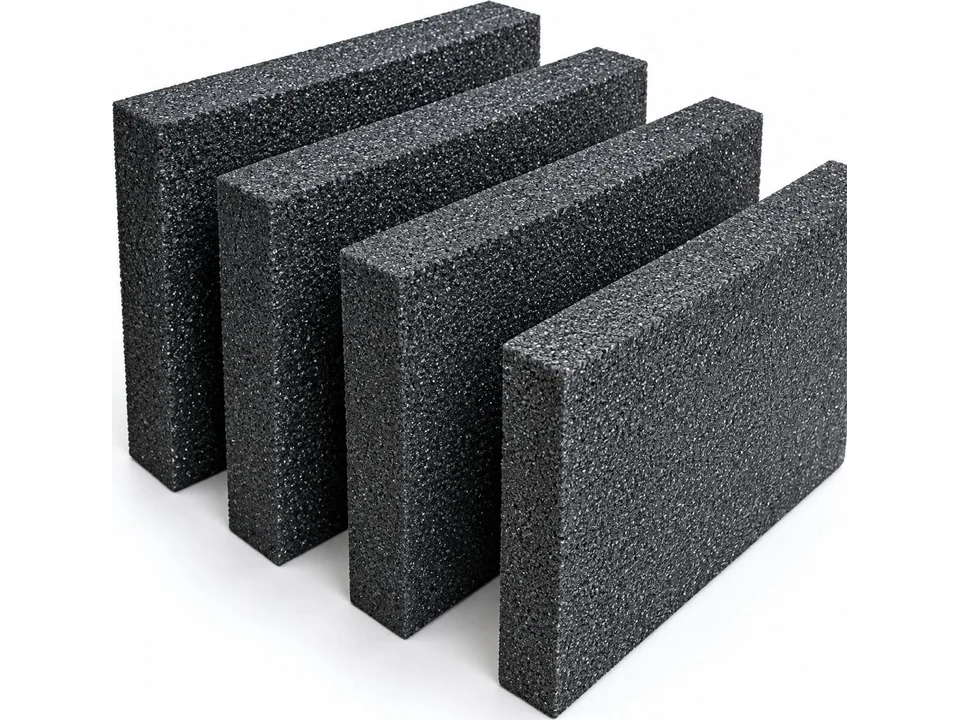
 HS 70080010
Cellular Glass Block & Pipe
Zero water absorption
Zero water-absorption insulation suitable for both hot and cryogenic lines, ideal where moisture ingress is a critical concern.
Also known as: foam glass insulation, cellular glass pipe insulation, closed-cell glass block
- Zero water absorption — fully impermeable
- Works across hot (up to 430°C) and cold applications
- Very high compressive strength
Technical data
| Block Size | 600 mm x 450 mm (standard) |
|---|---|
| Pipe NB Sizes | 15 mm to 600 mm |
| Thickness Options | 40 / 60 / 80 / 100 / 120 mm |
| Density | 100 - 165 kg/m³ |
| Temperature Range | 0°C to 430°C (both hot & cryogenic use) |
| Thermal Conductivity | 0.040 - 0.055 W/mK |
| Water Absorption | Zero (closed cell, impermeable) |
| Compressive Strength | Very high, 400-800 kPa |
| Vapour Permeability | Zero (fully impermeable, no vapour barrier needed) |
| Fire Rating | Non-combustible, Class A1 |
| Standards | ASTM C552 |
| Packing | Palletized, shrink-wrapped |
Applications
Standards
Manufacturer test certificates and data sheets can be supplied with the order on request.
Customs
Export packing
Palletized, shrink-wrapped. Loads are palletized or cartoned for ocean freight and can be consolidated with other products in one container.
Questions buyers ask
What is cellular glass insulation?
Cellular glass is a rigid, closed-cell glass foam insulation with zero water absorption and zero vapour permeability, supplied as blocks and pipe sections. It is used on moisture-critical hot and cold lines, including cryogenic and underground piping, where wet insulation would lose performance or cause corrosion under insulation.
What temperature range can cellular glass handle?
Cellular glass is used on hot lines up to 430°C and also on cold and cryogenic lines, covering both ends of the range with one material. Above 430°C, a higher-temperature material such as Calcium Silicate Block & Pipe Section or Rockwool Pipe Section is used instead.
Does cellular glass absorb water?
No, cellular glass has zero water absorption because its cells are closed and impermeable. Its vapour permeability is also zero, so the material itself acts as a vapour barrier, although joints on chilled lines still need to be fully sealed to stop moisture paths through the system.
What sizes of cellular glass block and pipe are available?
Cellular glass blocks are 600 mm x 450 mm, and pipe sections cover NB sizes from 15 mm to 600 mm. Thicknesses are 40, 60, 80, 100 and 120 mm, with density from 100 to 165 kg/m³. Pipe sections are specified by pipe NB size and thickness.
What is the compressive strength of cellular glass?
Cellular glass has a very high compressive strength of 400 to 800 kPa. This lets it carry load at pipe supports, under tank bases and in buried piping without crushing. It is rigid rather than flexible, so it does not recover if overloaded and must be protected from impact.
Cellular glass or PUF for chilled water lines?
Cellular Glass Block & Pipe is chosen where zero water absorption, non-combustibility and high compressive strength are critical, such as underground or load-bearing cold lines. PUF Pipe Section & Board has lower thermal conductivity and is lighter, and is widely used on general chilled-water piping with a proper vapour barrier.
How is cellular glass installed on cold pipes?
Cellular glass sections are fitted with tight, staggered joints that are sealed with a suitable joint sealant so no moisture path remains on chilled lines. Sections are secured with bands, then jacketed, for example with Aluminum Cladding Sheet & Coil. Butyl Mastic Sealant Tape can be used to seal jacket overlaps and penetrations.
What standard does cellular glass meet?
Cellular glass is supplied to ASTM C552, the standard specification for cellular glass thermal insulation. It is non-combustible, Class A1. If your project requires specific test reports against ASTM C552, mention it in your enquiry and we will confirm what is available for the order.
What HS code is used for cellular glass insulation?
Cellular glass insulation is exported under HS code 7008 00 10, a glass heading rather than the mineral wool heading used for rock wool. It ships palletized and shrink-wrapped to protect the rigid blocks and sections. Confirm the national tariff line with your customs broker.
Export markets
We ship Cellular Glass Block & Pipe to buyers worldwide. Country pages cover ports, standards and documents:
Complete the system.
Need Cellular Glass Block & Pipe shipped?
Tell us the size, thickness, grade and quantity with your destination port. We reply with a priced export offer, packing details and documents.