
 HS 39211390
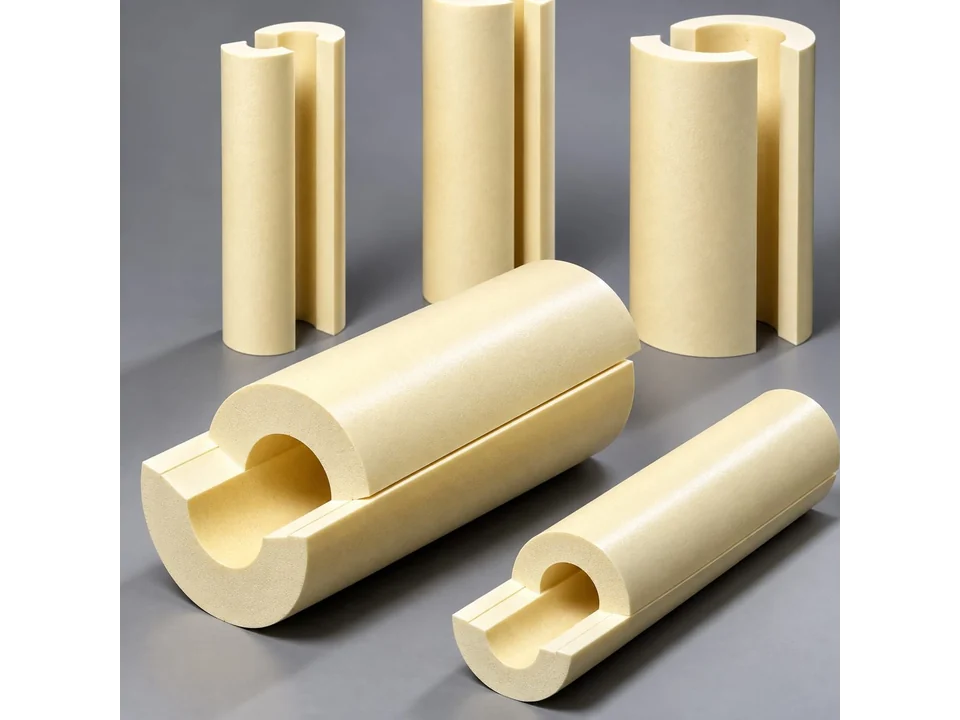
PUF Pipe Section & Board
Polyurethane foam, to −180°C
Rigid foam insulation with excellent low-temperature performance, used for cryogenic lines and cold storage, typically with aluminum cladding.
Also known as: polyurethane pipe section, PU foam insulation, PUR slab, cryogenic PU insulation
- Excellent low-temperature performance down to -180°C
- High closed-cell content (>90%) for superior insulation
- Aluminum/GI cladding options available
Technical data
| Pipe NB Sizes | 15 mm to 600 mm |
|---|---|
| Board Size | 1200 mm x 600 mm (standard) |
| Thickness Options | 25 / 40 / 50 / 75 / 100 mm |
| Density | 40 - 48 kg/m³ |
| Temperature Range | -180°C to +100°C |
| Thermal Conductivity | 0.022 - 0.028 W/mK |
| Compressive Strength | 150 - 250 kPa |
| Closed Cell Content | >90% |
| Cladding | Aluminum / GI sheet cladding available |
| Fire Rating | Self-extinguishing (with FR additive) |
| Standards | ASTM C591, IS 12436 |
| Packing | Shrink-wrapped, palletized |
Applications
Standards
Manufacturer test certificates and data sheets can be supplied with the order on request.
Customs
Export packing
Shrink-wrapped, palletized. Loads are palletized or cartoned for ocean freight and can be consolidated with other products in one container.
Questions buyers ask
What is PUF insulation used for?
PUF (rigid polyurethane foam) pipe section and board is cold insulation used on cryogenic lines, cold storage, and LPG and refrigeration piping. Its closed-cell content above 90% and thermal conductivity of 0.022 to 0.028 W/mK give strong insulating performance at moderate thickness. Compressive strength of 150 to 250 kPa helps it resist handling damage.
What temperature range can PUF insulation handle?
PUF pipe section and board is rated from -180°C to +100°C. The low limit suits cryogenic and LPG service, while the upper limit rules it out for steam or hot process lines, where Rockwool Pipe Section or Calcium Silicate Block & Pipe Section is used. On lines that alternate between cold and hot, check that the peak stays within +100°C.
What sizes, thicknesses and density does PUF pipe section come in?
PUF pipe sections are made for pipe sizes from 15 mm to 600 mm NB and boards in a standard 1200 x 600 mm size, both in 25, 40, 50, 75 and 100 mm thickness, with density of 40 to 48 kg/m³. On cold lines, thickness is chosen to keep the outer surface above dew point; thick systems are often built in layers with staggered joints.
What is the difference between PUF and PIR insulation?
PUF Pipe Section & Board and PIR Board are both rigid closed-cell foams with low thermal conductivity. PIR is generally chosen where better fire behavior is required, such as in building panels and ducts, while PUF is widely used for cold storage, refrigeration and cryogenic piping. PUF is self-extinguishing when made with a fire retardant additive, which should be specified in the enquiry.
PUF or cellular glass for cold and cryogenic lines?
Choose PUF Pipe Section & Board for lower conductivity and lighter weight on general cold and cryogenic piping and cold rooms, and Cellular Glass Block & Pipe where the insulation must be non-combustible, impermeable to water vapor and able to carry heavy loads. Cellular glass is often specified in fire-exposed areas and at pipe supports.
Does PUF insulation need a vapor barrier and cladding?
Yes, on cold and cryogenic lines PUF needs a continuous, sealed vapor barrier over the insulation, followed by weather protection such as Aluminum Cladding Sheet & Coil or GI cladding. Joints between sections must be tight and sealed, because moisture entering through gaps condenses or freezes and damages the insulation. Cladding on cold lines is best held with Insulation Band & Buckles so the barrier is not pierced.
What standards is PUF pipe section made to?
PUF pipe section and board is listed to ASTM C591 and IS 12436, the Indian standard for preformed rigid polyurethane and polyisocyanurate foam for thermal insulation. If your project specification refers to other standards or needs test reports, tell us in your enquiry and we will confirm what is available for your order.
Under which HS code is PUF insulation exported?
PUF pipe sections and boards are exported under HS code 39211390, which covers plates and sheets of cellular polyurethane. Importers should check the national sub-heading and duty rate with their customs broker, as preformed pipe sections may be treated differently from flat boards in some countries.
How is PUF insulation packed for export shipping?
PUF pipe sections and boards are shrink-wrapped and palletized, which keeps them clean and dry and protects edges during container loading. Because rigid foam is light but bulky, volume rather than weight usually fills the container, so 40′HC containers are often used. For a quotation, give pipe NB sizes, lengths, board quantities and thickness.
Export markets
We ship PUF Pipe Section & Board to buyers worldwide. Country pages cover ports, standards and documents:
Complete the system.
Nitrile Rubber Tube
Closed-cell elastomeric
Nitrile Rubber Sheet & Roll
Plain or self-adhesive
PIR Board
Polyisocyanurate, foil / tissue faced
Contact Adhesive
For nitrile rubber insulation
Need PUF Pipe Section & Board shipped?
Tell us the size, thickness, grade and quantity with your destination port. We reply with a priced export offer, packing details and documents.