
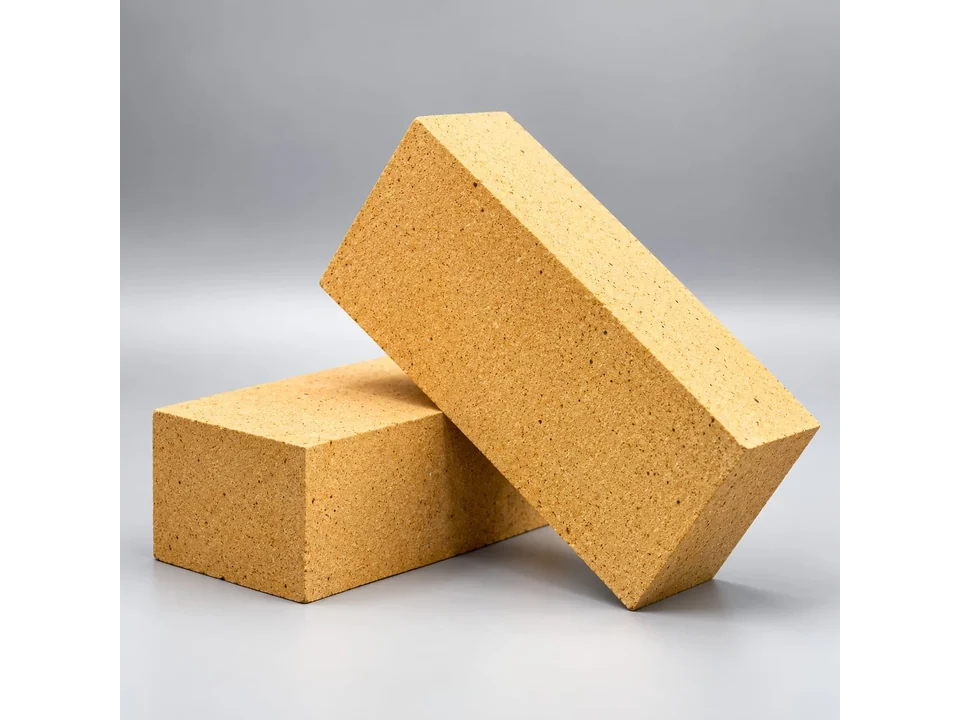
 HS 69010010
Insulating Fire Bricks (IFB)
SK-23 to SK-32 grades
Lightweight, highly porous refractory brick used as a backup insulation layer behind hot-face refractory to reduce heat loss.
Also known as: IFB brick, lightweight insulating brick, 26-grade insulating brick, insulation brick
- Very lightweight — low thermal conductivity
- Used as backup/insulating layer, not hot-face
- Available in multiple temperature grades
Technical data
| Standard Size | 230 x 114 x 65 mm / 230 x 114 x 75 mm |
|---|---|
| Temperature Grades | SK-23 (1150°C) / SK-26 (1350°C) / SK-30 (1500°C) / SK-32 (1650°C) |
| Bulk Density | 0.5 - 1.0 g/cm³ (lightweight) |
| Thermal Conductivity | 0.15 - 0.30 W/mK (at 600°C) |
| Cold Crushing Strength | 15 - 40 kg/cm² |
| Apparent Porosity | 55% - 75% |
| Standards | IS 8 (Part 2), ASTM C155 |
| Packing | Cartons on pallets (fragile, handle with care) |
Applications
Standards
Manufacturer test certificates and data sheets can be supplied with the order on request.
Customs
Export packing
Cartons on pallets (fragile, handle with care). Loads are palletized or cartoned for ocean freight and can be consolidated with other products in one container.
Questions buyers ask
What are insulating fire bricks (IFB) used for?
Insulating fire bricks (IFB) are lightweight, highly porous refractory bricks used as a backup insulation layer behind hot-face refractory and for furnace roof and wall insulation. Their high porosity gives low thermal conductivity, which reduces heat loss through the furnace shell and saves fuel. They are not intended as a hot-face lining where abrasion or slag is present.
What do the SK-23, SK-26, SK-30 and SK-32 grades of IFB mean?
The SK grades indicate the classification temperature of each insulating fire brick: SK-23 is rated 1150°C, SK-26 1350°C, SK-30 1500°C and SK-32 1650°C. Choose a grade whose rating is above the temperature the brick will actually see at its position in the lining. Higher grades cost more, so the grade is usually matched to the interface temperature.
What sizes are insulating fire bricks available in?
Insulating fire bricks are available in 230 x 114 x 65 mm and 230 x 114 x 75 mm sizes. The two thicknesses let the IFB course match the brickwork it backs up. Because IFB is soft and lightweight, it can also be cut on site to fit openings and odd shapes, which makes installation easier than with dense bricks.
What is the difference between Insulating Fire Bricks (IFB) and Fire Clay Bricks?
Insulating Fire Bricks (IFB) are lightweight bricks with 0.5 to 1.0 g/cm³ bulk density for insulation, while Fire Clay Bricks are dense bricks with 1.9 to 2.1 g/cm³ bulk density for structural linings. IFB conducts far less heat, 0.15 to 0.30 W/mK at 600°C against 0.8 to 1.0 W/mK, but is much weaker, so it usually sits behind a dense hot face.
What is the thermal conductivity of insulating fire bricks?
Insulating fire bricks have a thermal conductivity of 0.15 to 0.30 W/mK at 600°C, with apparent porosity of 55 to 75%. The large volume of trapped pores is what gives the low conductivity. Their cold crushing strength is only 15 to 40 kg/cm², so they should not carry heavy structural loads or be exposed to mechanical wear.
How should insulating fire bricks be installed and handled?
Insulating fire bricks should be laid with thin joints of a suitable Refractory Mortar and protected from impact, since they are fragile. Keep them dry and handle them with care during unloading and cutting. In a composite lining, the IFB course goes behind the hot-face brick or Castable Refractory, and Ceramic Fiber Blanket & Board is sometimes added for further insulation.
Which standards do insulating fire bricks conform to?
Insulating fire bricks conform to IS 8 (Part 2), the Indian standard for insulating refractory bricks, and ASTM C155, the standard classification of insulating firebrick. ASTM C155 groups bricks by classification temperature and bulk density. Include the required group or standard in your enquiry so the matching grade can be confirmed.
What customs code do insulating fire bricks come under?
Insulating fire bricks are shipped under HS code 69010010, bricks of siliceous fossil meals or similar siliceous earths. This is heading 6901, which is separate from the 6902 heading used for dense refractory bricks, so it is worth checking that your import declaration uses the correct heading. Your customs broker will confirm the local subheading and duty.
How are insulating fire bricks packed for sea freight?
Insulating fire bricks are packed in cartons on pallets and marked as fragile, because the lightweight bricks chip and break more easily than dense refractory. Cartons protect edges and corners during handling at port. IFB can be shipped in the same container as dense bricks, Refractory Mortar and Castable Refractory, provided it is stowed so heavier pallets do not bear on it.
Export markets
We ship Insulating Fire Bricks (IFB) to buyers worldwide. Country pages cover ports, standards and documents:
Complete the system.
Need Insulating Fire Bricks (IFB) shipped?
Tell us the size, thickness, grade and quantity with your destination port. We reply with a priced export offer, packing details and documents.