
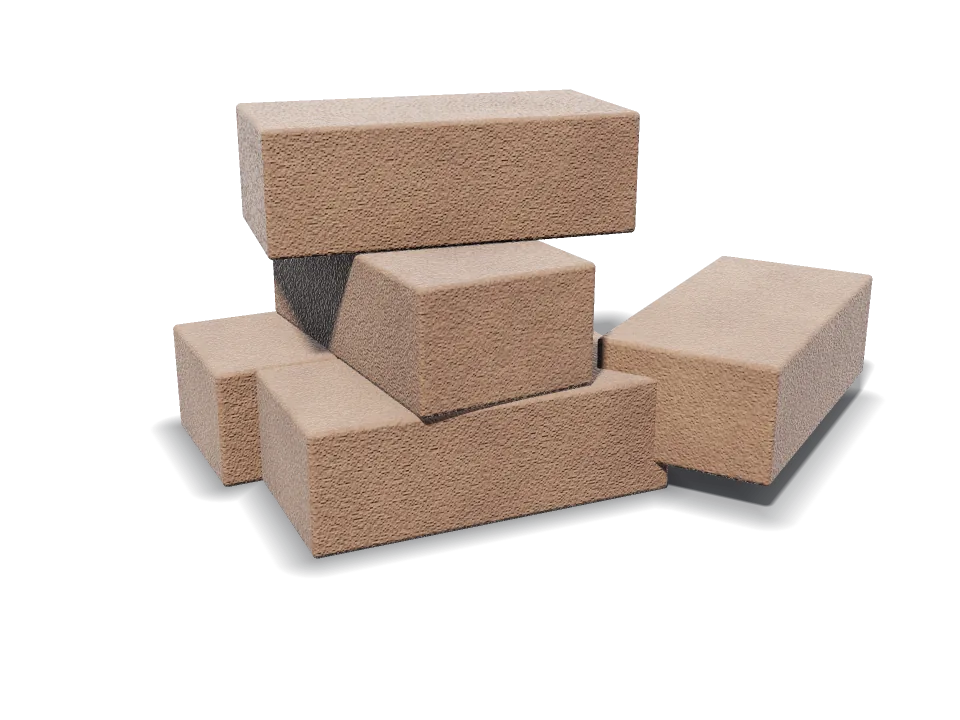
 HS 69021010Illustrative render
Basic / Magnesite Bricks
MgO 80–92%
High-MgO basic refractory brick used in steel-melting furnaces and cement kilns where high basicity slag resistance is required.
Also known as: magnesia brick, basic refractory brick, mag-chrome brick, MgO brick
- High resistance to basic slags (steel, cement industry)
- Excellent hot strength at very high temperatures
- Chrome-magnesite variants for extra strength
Technical data
| Standard Size | 230 x 114 x 75 mm (standard); custom shapes available |
|---|---|
| MgO Content | 80% - 92% (magnesite) / with Cr2O3 for chrome-magnesite |
| Max Service Temperature | 1700°C - 2000°C |
| Bulk Density | 2.8 - 3.1 g/cm³ |
| Cold Crushing Strength | 350 - 600 kg/cm² |
| Apparent Porosity | 14% - 20% |
| Standards | ASTM C455 |
| Packing | Wooden pallets, shrink-wrapped |
Applications
Standards
Manufacturer test certificates and data sheets can be supplied with the order on request.
Customs
Export packing
Wooden pallets, shrink-wrapped. Loads are palletized or cartoned for ocean freight and can be consolidated with other products in one container.
Questions buyers ask
What are magnesite bricks and where are they used?
Magnesite bricks are basic refractory bricks with 80 to 92% MgO, used in steel-melting furnaces (EAF and BOF), cement rotary kilns and lime kilns. They are called basic because their chemistry resists attack by basic slags, such as those in steelmaking and clinker production. Chrome-magnesite variants containing Cr2O3 are available where extra strength is required.
What is the maximum service temperature of magnesite bricks?
Magnesite bricks have a maximum service temperature of 1700°C to 2000°C, with good hot strength at very high temperatures. This places them among the highest-temperature refractories in this catalogue. In practice the service limit also depends on slag chemistry, atmosphere and thermal cycling, so the grade is chosen for the specific furnace zone.
What is the difference between magnesite and chrome-magnesite bricks?
Magnesite bricks are made mainly of MgO at 80 to 92%, while chrome-magnesite bricks also contain Cr2O3 for extra strength. Both are basic refractories for steel and cement applications. The choice depends on the furnace zone, slag conditions and any local rules on chrome-bearing materials, so state your application and preference in the enquiry.
Should I choose Basic / Magnesite Bricks or High Alumina Bricks?
Choose Basic / Magnesite Bricks where the lining faces basic slags, as in steel-melting furnaces and cement kilns, and High Alumina Bricks where slags are neutral to acidic or conditions are less severe. Magnesite serves up to 1700°C to 2000°C, while high alumina serves up to 1500°C to 1750°C. Matching refractory chemistry to slag chemistry is the main selection rule.
What are the physical properties of magnesite bricks?
Magnesite bricks have a bulk density of 2.8 to 3.1 g/cm³, cold crushing strength of 350 to 600 kg/cm² and apparent porosity of 14 to 20%. The high density and relatively low porosity limit slag penetration. They are supplied in the standard 230 x 114 x 75 mm size, and custom shapes are available for kilns and furnaces.
Do magnesite bricks need special storage or installation care?
Yes, magnesite bricks must be stored dry and under cover, because magnesia can react with moisture and damage the brick before use. They should not be laid in direct contact with acidic refractories such as silica bricks at high temperature. Use a compatible basic mortar, follow the kiln or furnace supplier's joint and expansion design, and heat the new lining up gradually.
Which standard covers magnesite bricks?
Magnesite bricks in this catalogue are referenced to ASTM C455. The main selection points are MgO content, density, cold crushing strength and service temperature, listed in the technical data table. If your specification calls for a particular MgO level or class, tell us in your enquiry and we will confirm what is available for your order.
What HS code should I use to import magnesite bricks?
Magnesite bricks are exported from India under HS code 69021010, refractory bricks and shapes of magnesite. Heading 6902 covers refractory bricks, blocks and tiles, and subheading 690210 applies where magnesium, calcium or chromium oxides dominate. Import duties and final national digits are set by your country, so confirm the classification with your customs broker.
How are magnesite bricks packed to protect them from moisture during shipping?
Magnesite bricks are packed on wooden pallets and shrink-wrapped, which gives a barrier against moisture during sea transit and port storage. On arrival they should be moved into dry, covered storage and kept wrapped until use. For kiln relines, send the shape schedule and quantities per shape with your enquiry, as custom shapes are quoted individually.
Export markets
We ship Basic / Magnesite Bricks to buyers worldwide. Country pages cover ports, standards and documents:
Complete the system.
Need Basic / Magnesite Bricks shipped?
Tell us the size, thickness, grade and quantity with your destination port. We reply with a priced export offer, packing details and documents.