
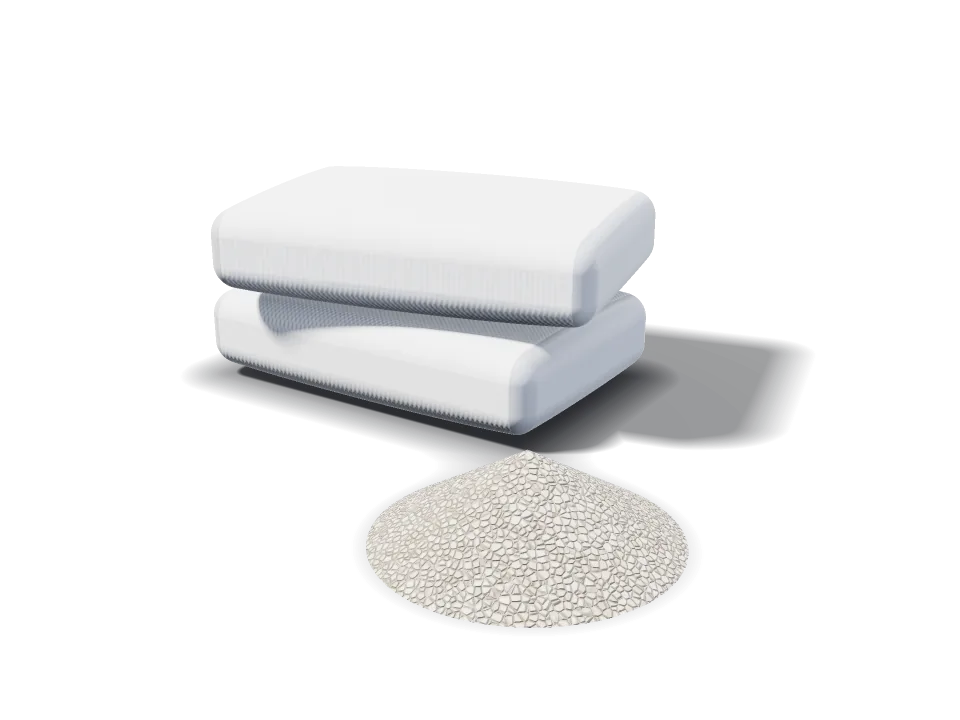
 HS 38160000Illustrative render
Ramming Mass
Silica, dolomite, quartzite
Granular refractory material rammed in place (typically as furnace lining/bottom) for induction furnaces and ladles, forming a monolithic sintered lining.
Also known as: silica ramming mass, induction furnace lining, dolomite ramming mix, refractory ramming
- Forms monolithic sintered lining after ramming & sintering
- Common types: Silica, Dolomite, Magnesia, Quartzite
- Widely used in induction furnace linings
Technical data
| Type | Silica Ramming Mass / Dolomite Ramming Mass / Quartzite Ramming Mass |
|---|---|
| SiO2 / MgO Content | SiO2 >96% (silica type) / MgO >85% (dolomite type) |
| Max Service Temperature | 1650°C - 1750°C |
| Grain Size | 0-6 mm graded aggregate (typical) |
| Form | Dry granular powder, rammed manually or pneumatically |
| Sintered Density | 2.2 - 3.0 g/cm³ (type dependent) |
| Standards | ASTM C862 |
| Packing | 25 / 50 kg HDPE bags |
Applications
Standards
Manufacturer test certificates and data sheets can be supplied with the order on request.
Customs
Export packing
25 / 50 kg HDPE bags. Loads are palletized or cartoned for ocean freight and can be consolidated with other products in one container.
Questions buyers ask
What is ramming mass in an induction furnace?
Ramming mass is a dry granular refractory that is rammed in place to form the lining of induction furnaces, ladle bottoms and cupola furnaces. After ramming and sintering it forms a monolithic sintered lining without joints. It is installed dry, rammed manually or pneumatically, rather than mixed with water like a castable.
What is the maximum temperature of ramming mass?
Ramming mass is rated for maximum service temperatures of 1650°C to 1750°C, depending on the type. The limit depends on the chemistry of the mass and on the metal and slag being melted, so the type should be chosen to suit the furnace duty and the melt.
What is the difference between silica, dolomite and quartzite ramming mass?
Silica and quartzite ramming masses are acidic, silica-based linings, with SiO2 above 96% for the silica type, while dolomite ramming mass is basic, with MgO above 85%. The choice depends mainly on the metal and slag chemistry in the furnace, because an acidic lining and a basic slag, or the reverse, react with each other.
What grain size is ramming mass supplied in?
Ramming mass is typically supplied as a 0-6 mm graded aggregate. The graded mix of coarse and fine particles packs densely when rammed, giving a sintered density of 2.2 to 3.0 g/cm³ depending on type. Keep the mass dry and avoid segregating the fines during handling so the lining compacts evenly.
How is ramming mass installed and sintered?
Ramming mass is placed dry in layers and compacted manually or pneumatically around a former, then sintered by a controlled first heat to form a monolithic lining. Even compaction in each layer is important to avoid weak zones. The heating schedule should follow the furnace operator's practice for the type of ramming mass used.
How does ramming mass compare with castable refractory?
Ramming mass is a dry granular material rammed and sintered in place, mainly for induction furnace linings, while Castable Refractory is mixed with water and cast, gunned or pumped for furnace roofs, walls, ladles and shaped parts. Ramming mass suits linings in direct contact with molten metal in induction furnaces; castable suits a wider range of furnace structures.
Which standard applies to ramming mass?
Ramming mass in this catalogue is referenced to ASTM C862. Selection is based on type, chemistry, grain size and service temperature, so share your furnace type, capacity and the metal being melted. If you need specific test documentation for an order, ask in your enquiry and we will confirm what is available.
What HS code is ramming mass exported under?
Ramming mass is exported under HS code 38160000, covering refractory cements, mortars, concretes and similar compositions, including dolomite ramming mix. Silica, quartzite and dolomite types are all declared under this heading, the same one used for Castable Refractory and Refractory Mortar in a mixed refractory shipment.
How is ramming mass packed for export shipments?
Ramming mass is packed in 25 kg or 50 kg HDPE bags, which help keep the dry granular material free of moisture in transit. It ships FCL or LCL from Nhava Sheva (JNPT) or Mumbai under EXW, FCA, FOB, CFR or CIF terms. In your enquiry, give the type, quantity in tonnes and destination port.
Export markets
We ship Ramming Mass to buyers worldwide. Country pages cover ports, standards and documents:
Complete the system.
Need Ramming Mass shipped?
Tell us the size, thickness, grade and quantity with your destination port. We reply with a priced export offer, packing details and documents.