
 HS 38160000
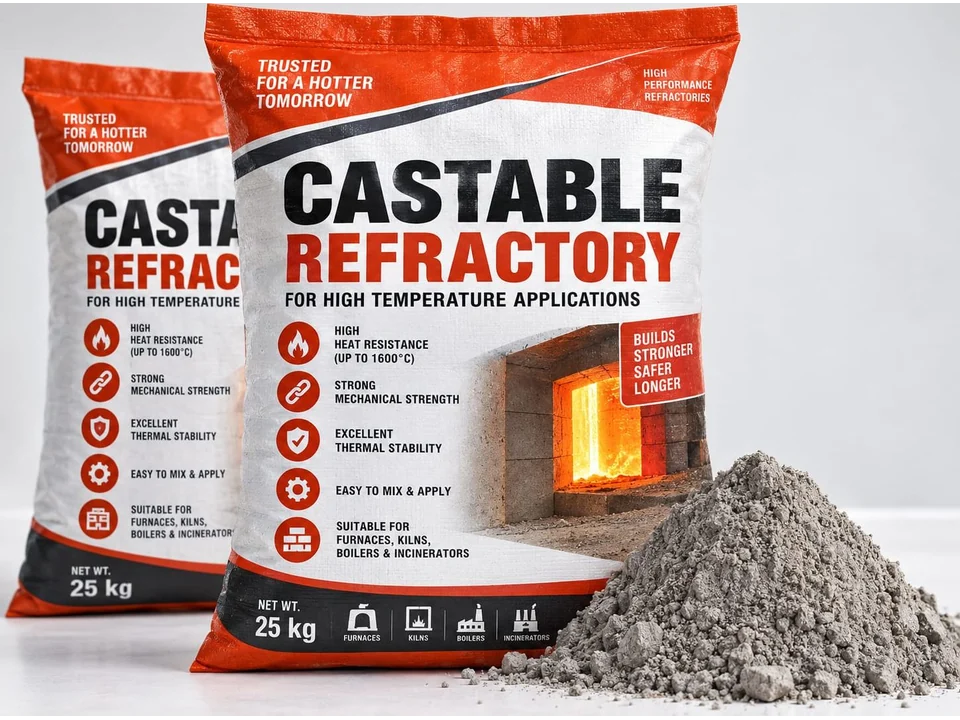
Castable Refractory
LCC, high alumina & insulating
Monolithic refractory material poured/cast in place for furnace linings, kiln parts, and complex-shaped hot-face applications where bricklaying isn't practical.
Also known as: refractory castable, low cement castable, LCC castable, insulating castable
- No brick-laying needed — poured/cast/gunned in place
- Low Cement Castable (LCC) grades reduce porosity for better performance
- Grades available for 1000°C to 1800°C service
Technical data
| Type | Low Cement Castable (LCC) / High Alumina Castable / Insulating Castable |
|---|---|
| Al2O3 Content | 42% / 60% / 70% / 80% / 90% (grade dependent) |
| Max Service Temperature | 1000°C - 1800°C (grade dependent) |
| Packing Size | 25 kg / 40 kg bags |
| Water Requirement | 6% - 9% by weight (grade dependent) |
| Setting Time | Initial: 20-40 min / Final: 4-8 hrs |
| Cold Crushing Strength (after firing) | 400 - 900 kg/cm² |
| Application Method | Casting, gunning, ramming, or pumping |
| Standards | ASTM C401, IS 6913 |
| Packing | 25/40 kg HDPE-lined paper bags |
Applications
Standards
Manufacturer test certificates and data sheets can be supplied with the order on request.
Customs
Export packing
25/40 kg HDPE-lined paper bags. Loads are palletized or cartoned for ocean freight and can be consolidated with other products in one container.
Questions buyers ask
What is castable refractory and where is it used?
Castable refractory is a monolithic refractory that is mixed with water and poured, cast, gunned, rammed or pumped in place instead of being laid as bricks. It is used for furnace roofs and walls, ladles, tundishes, kiln nose rings and burner blocks, and for complex hot-face shapes where bricklaying is not practical. Once set and fired it forms a jointless lining.
What is the maximum service temperature of castable refractory?
Castable refractory is available for maximum service temperatures from 1000°C up to 1800°C, depending on the grade. The limit is set mainly by the alumina content and the type of castable: insulating castables sit at the lower end, while high alumina and low cement grades with higher Al2O3 cover the upper end. Choose a grade rated above your actual hot-face temperature.
Which alumina grades of castable refractory are available?
Castable refractory is supplied with 42%, 60%, 70%, 80% or 90% Al2O3, in Low Cement Castable (LCC), High Alumina Castable and Insulating Castable types. Higher alumina generally suits higher temperatures and more severe slag or abrasion service, while insulating castable is used where lower heat loss and lighter weight matter more than strength. Share your temperature and operating conditions and we will suggest a grade.
How much water does castable refractory need and how long does it take to set?
Castable refractory typically needs 6% to 9% water by weight, depending on the grade, with initial set in 20 to 40 minutes and final set in 4 to 8 hours. Adding more water than specified weakens the lining and increases porosity, so measure water accurately and mix only what can be placed within the working time.
How strong is castable refractory after firing?
Castable refractory reaches a cold crushing strength of 400 to 900 kg/cm² after firing, depending on the grade. Dense LCC and high alumina grades sit toward the upper end, while insulating castables trade strength for lower density and heat loss. Correct water addition, compaction and curing are needed to reach the rated strength on site.
Does castable refractory need a dry-out before use?
Yes, a new castable refractory lining needs curing followed by a controlled first heat-up, or dry-out, before full operating temperature. Heating too quickly can turn trapped moisture into steam and cause spalling or cracking. Anchors are normally used to hold wall and roof linings, and Insulating Fire Bricks (IFB) or Ceramic Fiber Blanket & Board can be used as backup insulation behind the castable.
Which standards apply to castable refractory?
Castable refractory in this catalogue is referenced to ASTM C401 and IS 6913. ASTM C401 is the standard classification for alumina and alumina-silicate castable refractories. If your specification calls for specific test reports for an order, mention it in your enquiry and we will confirm what can be provided with the quotation.
What is the HS code for castable refractory?
Castable refractory is shipped under HS code 38160000, which covers refractory cements, mortars, concretes and similar compositions. The same heading is used for Refractory Mortar and Ramming Mass, so refractory monolithics can be declared consistently when they travel together in one export shipment.
How is castable refractory packed and shipped for export?
Castable refractory is packed in 25 kg or 40 kg HDPE-lined paper bags, which help protect the cement-bonded powder from moisture during sea freight. Bags can be shipped in FCL 20′, 40′ or 40′HC containers or as LCL from Nhava Sheva (JNPT) or Mumbai, and can be combined with bricks, mortar and insulation in one container. Tell us the grade and tonnage in your enquiry.
Export markets
We ship Castable Refractory to buyers worldwide. Country pages cover ports, standards and documents:
Complete the system.
Need Castable Refractory shipped?
Tell us the size, thickness, grade and quantity with your destination port. We reply with a priced export offer, packing details and documents.